Command & control

The world of command centers

Every critical operation in the physical world runs through a room like this.

Command & control centers (GSOCs, SOCs, OCCs) are mission control for the physical world: security, transit, utilities, defense, manufacturing.

They all share the same anatomy: a video wall, sensor inputs, and human operators making decisions under time pressure.
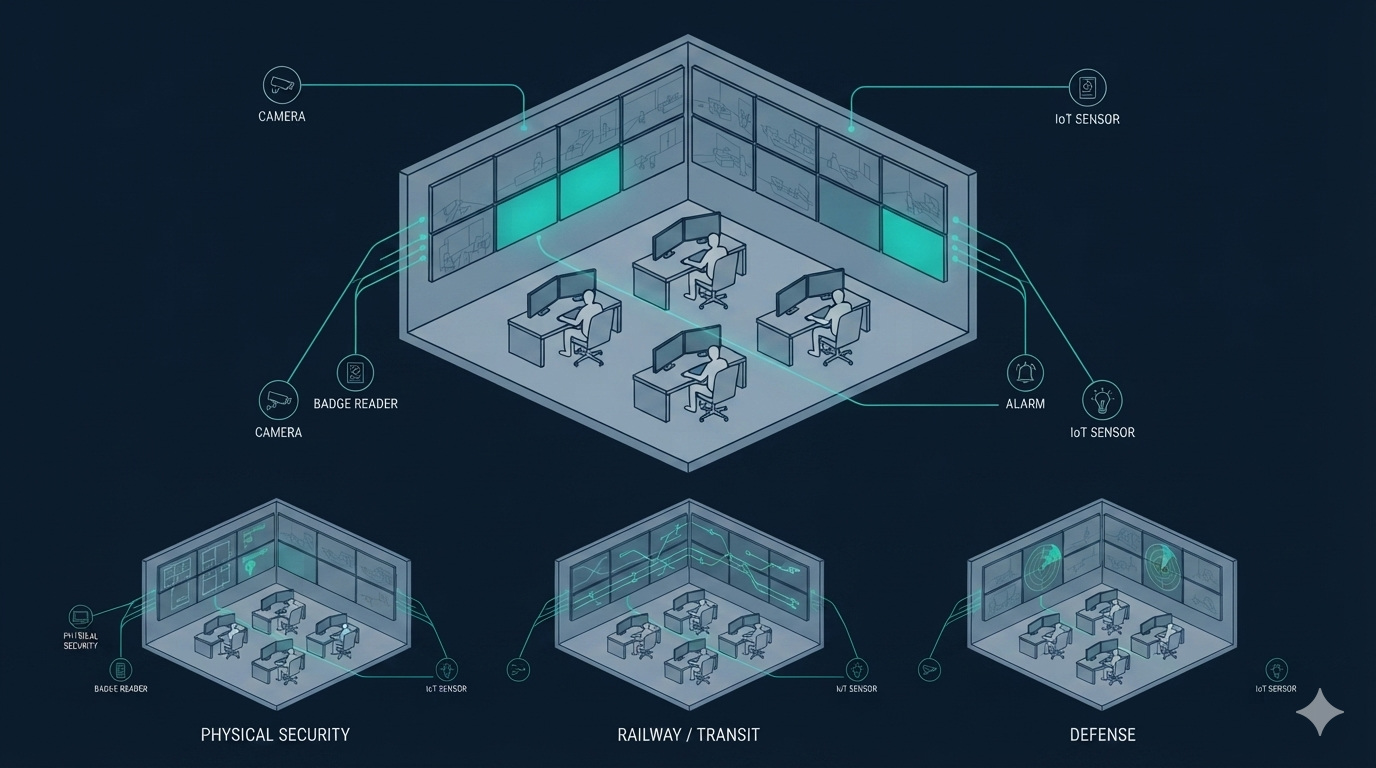
Anatomy of a command centre: a video wall, sensor inputs, and operators.
The problem

Humans are the correlation engine

The operator is the integration layer.

Video, alarms, access events, and telemetry arrive as separate streams. A human mentally fuses them.

The modern control room fails silently: cognitive load climbs, situational awareness falls, and nothing in the room measures either.
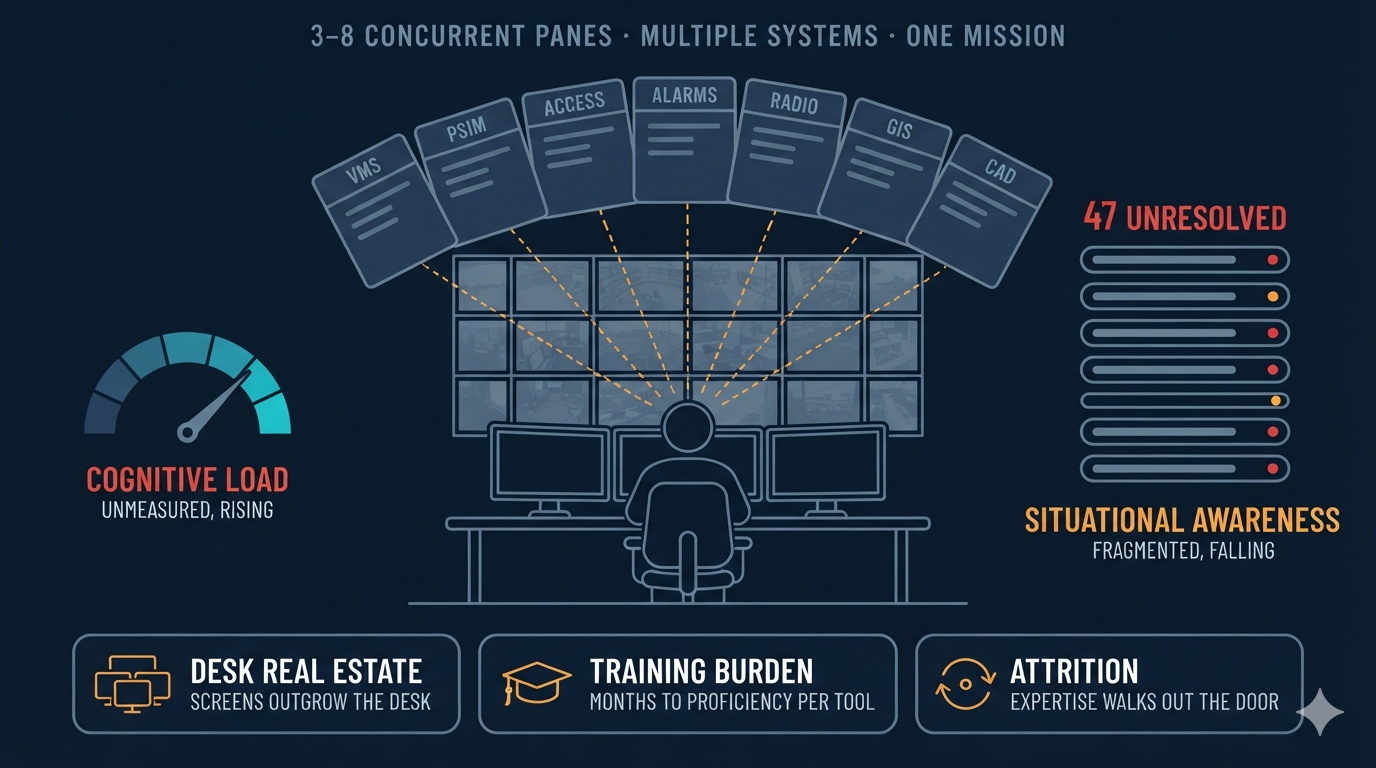
Chart: as inputs multiply, cognitive load rises while situational awareness falls.
Cognitive overload
One operator juggles 3–8 concurrent panes across separate systems. Attention is the scarcest resource in the room, and every tool competes for it.
False alarm flood
Uncorroborated single-sensor alerts. Real events drown.
Fragmented awareness
Correlation happens only in the operator's head. The badge event, the camera view, and the alarm never meet on screen.
Human cost structure
Desk real estate limits how many screens fit. Each tool takes months to master. Attrition removes trained operators, and their expertise leaves with them.
The platform

Forty panes become one scene

An AI-native system running the full OODA loop: observe, orient, decide, act.
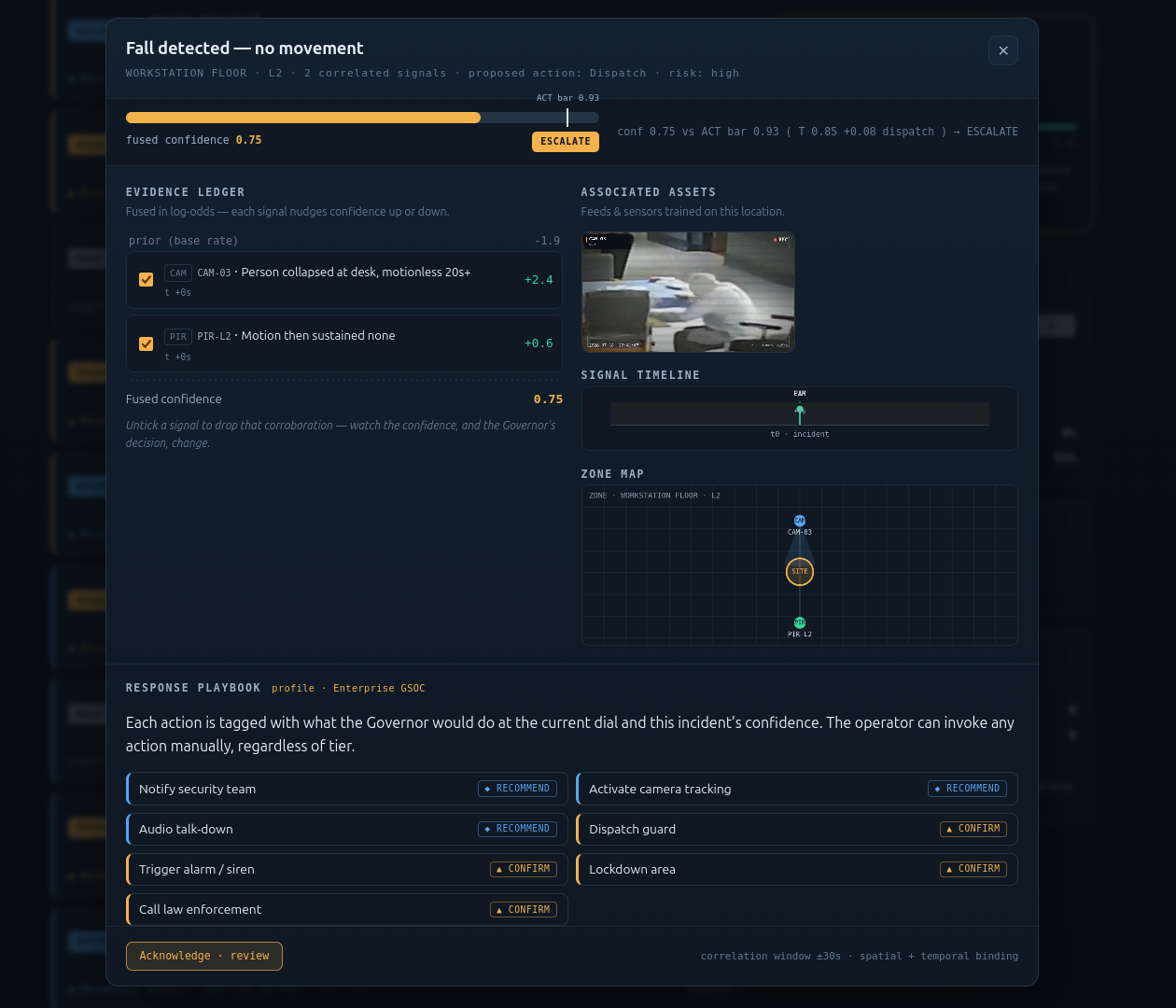
An incident opened out: evidence ledger fusing camera and PIR signals in log-odds into a single confidence score, associated feeds, signal timeline, zone map, and a response playbook where each action is tagged recommend or confirm.
Perceive
observe + orient: real situational awareness
Continuous reasoning — intent and behaviour over time, not frames
Video + sensor fusion — every alert corroborated across streams
Live digital twin — multi-camera tracking on one site model
3D immersive view — the site, not forty panes (roadmap)
Act
decide + act: calibrated autonomous action
Recommended actions — each course of action carries a score
Autonomous playbooks — executed above the threshold
Action panel integration — no rip-and-replace
Decision trail capture — every step audit-ready
Privacy by design
Anonymization at the source protects identity before data reaches the reasoning layer, and explainable AI means every score comes with the reasoning behind it, not a black-box number.
The wedge

The confidence dial

The first C2 platform where the customer sets how autonomous it is.

Autonomy in C2 today is binary: a human gate on everything, or a black box. Here the threshold is a setting, and the same event stream changes behaviour when it moves.
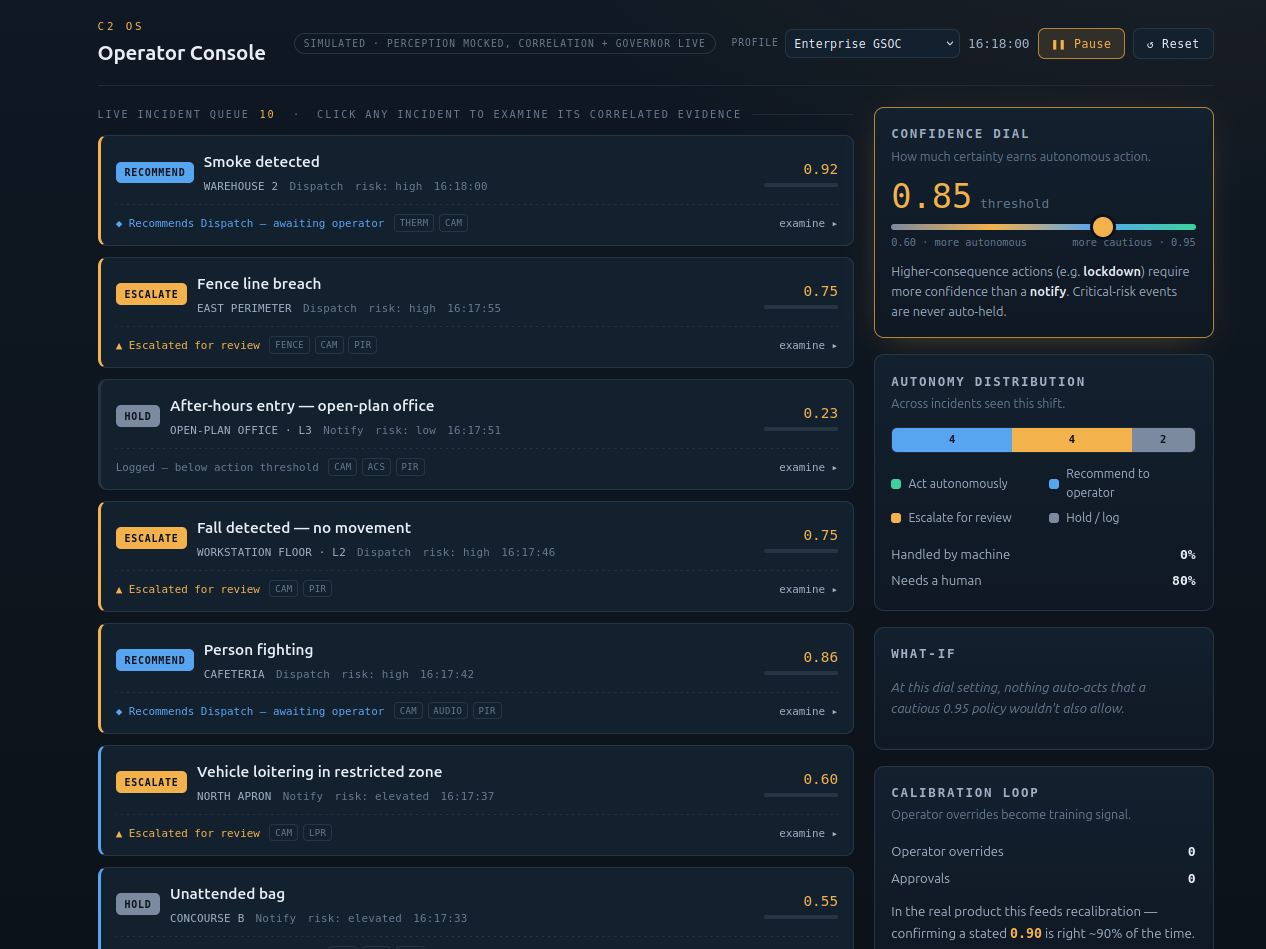
Operator console: a live incident queue where each event carries a confidence score and a recommend, escalate or hold tier, beside the confidence dial set to 0.85 and an autonomy distribution across the shift.
The dial in the product: every incident scored, then tiered against the threshold. Higher-consequence actions require more confidence than a notify.
Below the threshold
The platform recommends a course of action with its score.
Above it
The playbook runs, and every step lands in an immutable, auditable action trail.
Calibration
Set per-site and per-event-class, and it moves as the customer earns trust.
Autonomy becomes a dial the customer turns, not a promise the vendor makes.
Outcomes

What changes on the operations floor

Response time, decision quality, audit trail, coverage per operator.
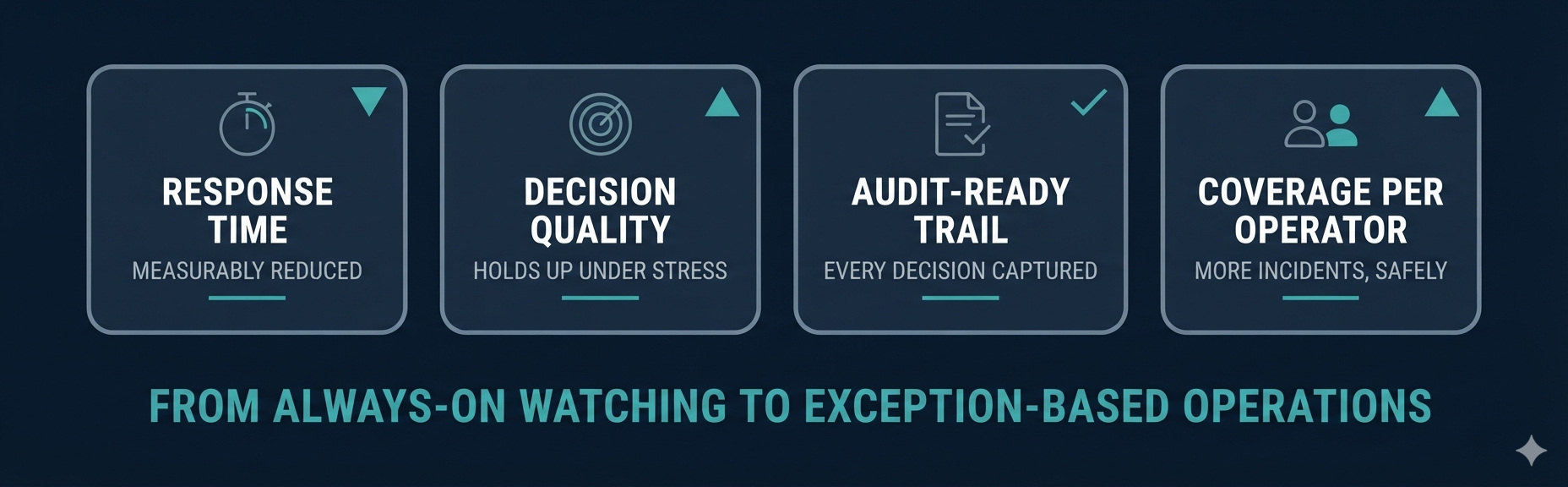
Response time, decision quality, audit-ready trail, and coverage per operator.
Operator role
Shifts from watching everything to orchestrating autonomous workflows.
Operations model
Exception-based, not always-on. The system directs attention and surfaces what changed and why it matters.
Compliance
Every decision captured in an audit-ready trail that satisfies compliance out of the box.
Market & timing

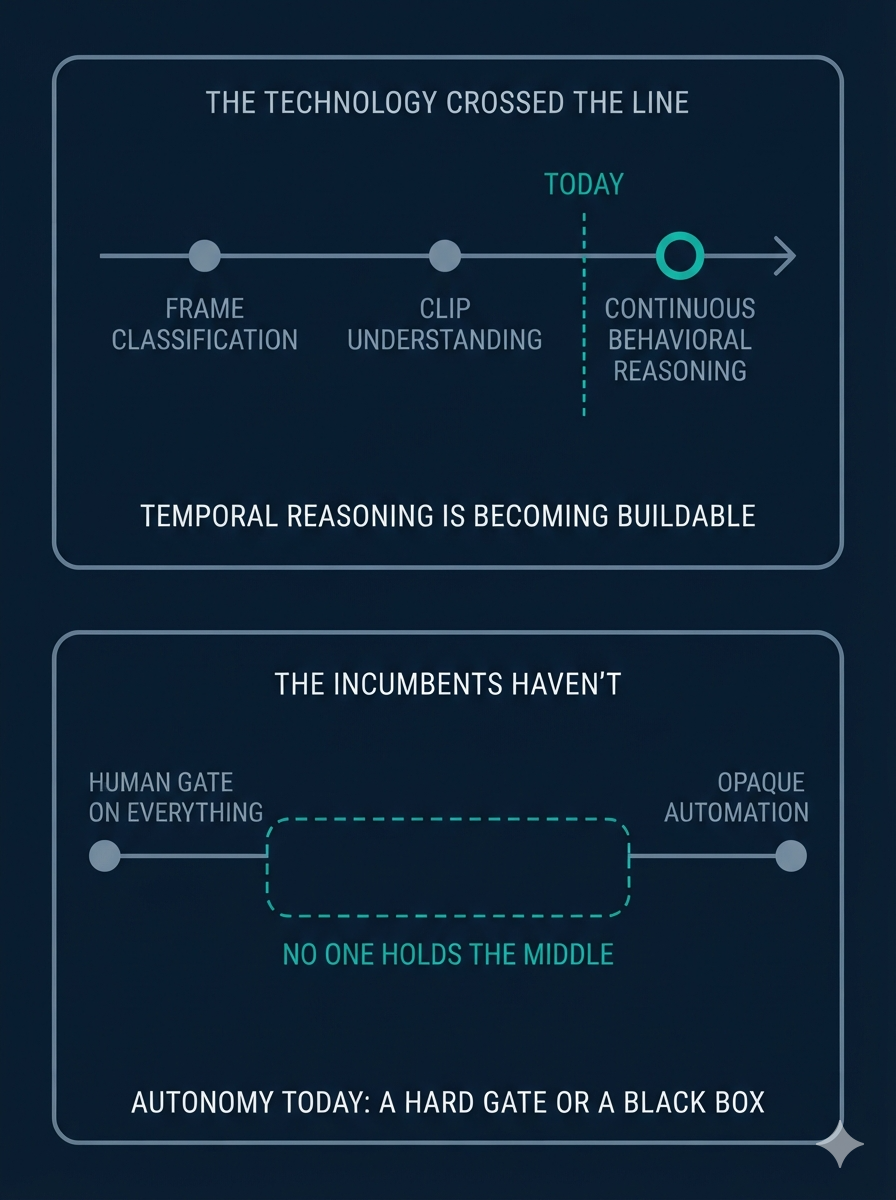
The technology crossed the line. The incumbents haven't.
$42.85B
Global security operations center market, 2024
7.9%
CAGR through 2034 (Polaris Market Research)
4
Live procurement programs scoring cognitive assistance as a requirement
01
Vision-language models now reason about behaviour over time.
Purpose-built temporal models are moving from labs into deployable form. Continuous scene understanding is now buildable.
02
No incumbent exposes calibrated autonomy.
Existing platforms either keep a hard human gate on every action, or automate opaquely with no customer-visible control.
03
Demand pull.
Cognitive assistance appears as a scored requirement in live procurement across geographies and sectors: US Air Force, India Army, India Smart City, Europe physical security.
Top: the shift from frame classification to continuous behavioural reasoning. Bottom: no vendor holds the middle ground between a human gate on everything and opaque automation.
Where we start

Beachhead and expansion

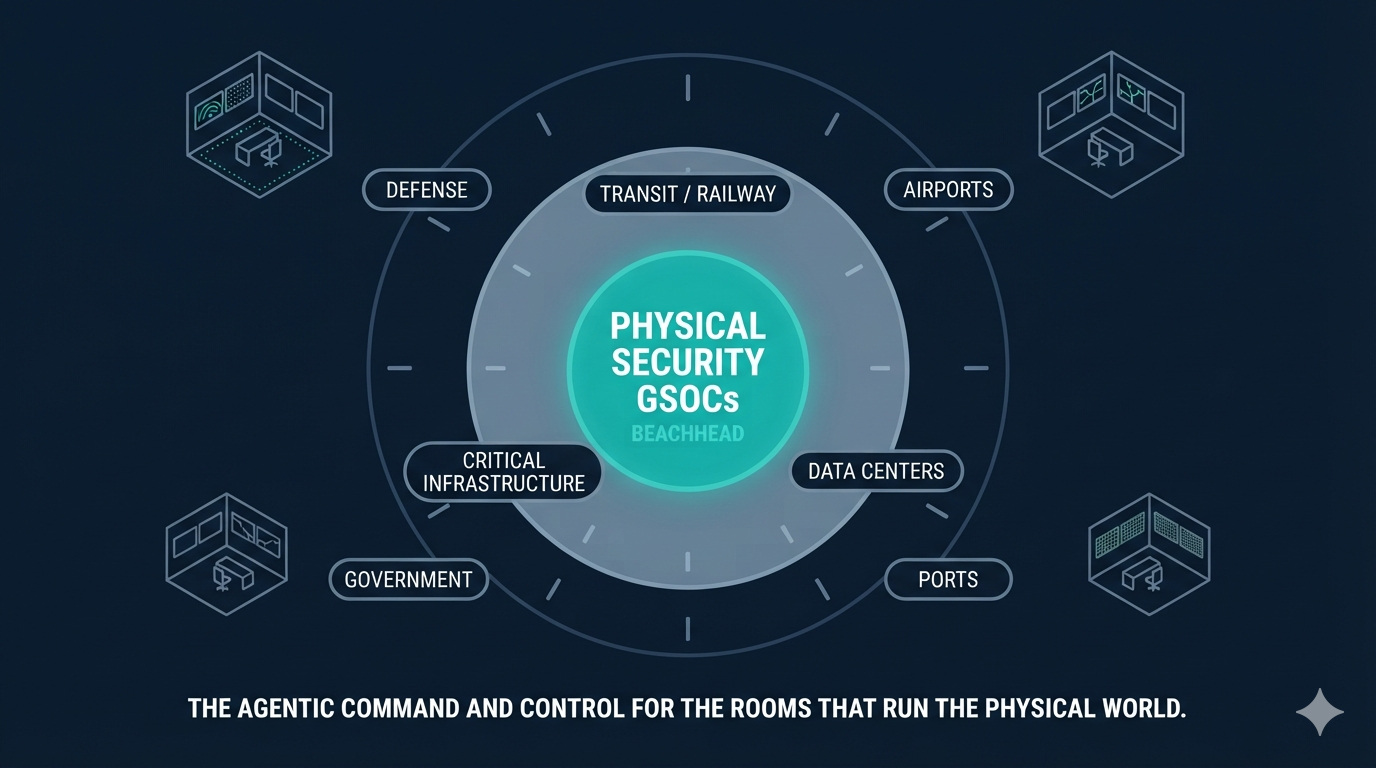
Start where the pain is sharpest. Expand to every room with the same anatomy.
Beachhead
Physical security GSOCs.
Expansion
Transit and railway OCCs, critical infrastructure, defence, ports, airports.
Command and control centres share the same anatomy everywhere: a video wall, sensor inputs, and human operators deciding under time pressure.
Physical security GSOCs at the centre, expanding out to transit, airports, data centres, ports, government, critical infrastructure and defence.
C2 OS

Agentic command and control for the rooms running the physical world

Start a conversation {{ contactEmail }}
Company
LucidWatch Technologies
Stage
Validation stage
Separating the signal from the noise
Command & control

The world of command centers

Every critical operation in the physical world runs through a room like this.

Command & control centers (GSOCs, SOCs, OCCs) are mission control for the physical world: security, transit, utilities, defense, manufacturing.

They all share the same anatomy: a video wall, sensor inputs, and human operators making decisions under time pressure.

Anatomy of a command centre: a video wall, sensor inputs, and operators.
The problem

Humans are the correlation engine

The operator is the integration layer.

Video, alarms, access events, and telemetry arrive as separate streams. A human mentally fuses them.

The modern control room fails silently: cognitive load climbs, situational awareness falls, and nothing in the room measures either.

Chart: as inputs multiply, cognitive load rises while situational awareness falls.
Cognitive overload
One operator juggles 3–8 concurrent panes across separate systems. Attention is the scarcest resource in the room, and every tool competes for it.
False alarm flood
Uncorroborated single-sensor alerts. Real events drown.
Fragmented awareness
Correlation happens only in the operator's head. The badge event, the camera view, and the alarm never meet on screen.
Human cost structure
Desk real estate limits how many screens fit. Each tool takes months to master. Attrition removes trained operators, and their expertise leaves with them.
The platform

Forty panes become one scene

An AI-native system running the full OODA loop: observe, orient, decide, act.

An incident opened out: evidence ledger fusing camera and PIR signals in log-odds into a single confidence score, associated feeds, signal timeline, zone map, and a response playbook where each action is tagged recommend or confirm.
Perceive
observe + orient: real situational awareness
Continuous reasoning — intent and behaviour over time, not frames
Video + sensor fusion — every alert corroborated across streams
Live digital twin — multi-camera tracking on one site model
3D immersive view — the site, not forty panes (roadmap)
Act
decide + act: calibrated autonomous action
Recommended actions — each course of action carries a score
Autonomous playbooks — executed above the threshold
Action panel integration — no rip-and-replace
Decision trail capture — every step audit-ready
Privacy by design
Anonymization at the source protects identity before data reaches the reasoning layer, and explainable AI means every score comes with the reasoning behind it, not a black-box number.
The wedge

The confidence dial

The first C2 platform where the customer sets how autonomous it is.

Autonomy in C2 today is binary: a human gate on everything, or a black box. Here the threshold is a setting, and the same event stream changes behaviour when it moves.

Operator console: a live incident queue where each event carries a confidence score and a recommend, escalate or hold tier, beside the confidence dial set to 0.85 and an autonomy distribution across the shift.
The dial in the product: every incident scored, then tiered against the threshold. Higher-consequence actions require more confidence than a notify.
Below the threshold
The platform recommends a course of action with its score.
Above it
The playbook runs, and every step lands in an immutable, auditable action trail.
Calibration
Set per-site and per-event-class, and it moves as the customer earns trust.
Autonomy becomes a dial the customer turns, not a promise the vendor makes.
Outcomes

What changes on the operations floor

Response time, decision quality, audit trail, coverage per operator.

Response time, decision quality, audit-ready trail, and coverage per operator.
Operator role
Shifts from watching everything to orchestrating autonomous workflows.
Operations model
Exception-based, not always-on. The system directs attention and surfaces what changed and why it matters.
Compliance
Every decision captured in an audit-ready trail that satisfies compliance out of the box.
Market & timing

The technology crossed the line. The incumbents haven't.

$42.85B
Global security operations center market, 2024
7.9%
CAGR through 2034 (Polaris Market Research)
4
Live procurement programs scoring cognitive assistance as a requirement
01
Vision-language models now reason about behaviour over time.
Purpose-built temporal models are moving from labs into deployable form. Continuous scene understanding is now buildable.
02
No incumbent exposes calibrated autonomy.
Existing platforms either keep a hard human gate on every action, or automate opaquely with no customer-visible control.
03
Demand pull.
Cognitive assistance appears as a scored requirement in live procurement across geographies and sectors: US Air Force, India Army, India Smart City, Europe physical security.
Top: the shift from frame classification to continuous behavioural reasoning. Bottom: no vendor holds the middle ground between a human gate on everything and opaque automation.
Where we start

Beachhead and expansion

Start where the pain is sharpest. Expand to every room with the same anatomy.

Beachhead
Physical security GSOCs.
Expansion
Transit and railway OCCs, critical infrastructure, defence, ports, airports.
Command and control centres share the same anatomy everywhere: a video wall, sensor inputs, and human operators deciding under time pressure.
Physical security GSOCs at the centre, expanding out to transit, airports, data centres, ports, government, critical infrastructure and defence.
C2 OS

Agentic command and control for the rooms running the physical world

Start a conversation {{ contactEmail }}
Company
LucidWatch Technologies
Stage
Validation stage
Separating the signal from the noise
Command & control

The world of command centers

Every critical operation in the physical world runs through a room like this.

Command & control centers (GSOCs, SOCs, OCCs) are mission control for the physical world: security, transit, utilities, defense, manufacturing.

They all share the same anatomy: a video wall, sensor inputs, and human operators making decisions under time pressure.

Anatomy of a command centre: a video wall, sensor inputs, and operators.
The problem

Humans are the correlation engine

The operator is the integration layer.

Video, alarms, access events, and telemetry arrive as separate streams. A human mentally fuses them.

The modern control room fails silently: cognitive load climbs, situational awareness falls, and nothing in the room measures either.

Chart: as inputs multiply, cognitive load rises while situational awareness falls.
Cognitive overload
One operator juggles 3–8 concurrent panes across separate systems. Attention is the scarcest resource in the room, and every tool competes for it.
False alarm flood
Uncorroborated single-sensor alerts. Real events drown.
Fragmented awareness
Correlation happens only in the operator's head. The badge event, the camera view, and the alarm never meet on screen.
Human cost structure
Desk real estate limits how many screens fit. Each tool takes months to master. Attrition removes trained operators, and their expertise leaves with them.
The platform

Forty panes become one scene

An AI-native system running the full OODA loop: observe, orient, decide, act.

An incident opened out: evidence ledger fusing camera and PIR signals in log-odds into a single confidence score, associated feeds, signal timeline, zone map, and a response playbook where each action is tagged recommend or confirm.
Perceive
observe + orient: real situational awareness
Continuous reasoning — intent and behaviour over time, not frames
Video + sensor fusion — every alert corroborated across streams
Live digital twin — multi-camera tracking on one site model
3D immersive view — the site, not forty panes (roadmap)
Act
decide + act: calibrated autonomous action
Recommended actions — each course of action carries a score
Autonomous playbooks — executed above the threshold
Action panel integration — no rip-and-replace
Decision trail capture — every step audit-ready
Privacy by design
Anonymization at the source protects identity before data reaches the reasoning layer, and explainable AI means every score comes with the reasoning behind it, not a black-box number.
The wedge

The confidence dial

The first C2 platform where the customer sets how autonomous it is.

Autonomy in C2 today is binary: a human gate on everything, or a black box. Here the threshold is a setting, and the same event stream changes behaviour when it moves.

Operator console: a live incident queue where each event carries a confidence score and a recommend, escalate or hold tier, beside the confidence dial set to 0.85 and an autonomy distribution across the shift.
The dial in the product: every incident scored, then tiered against the threshold. Higher-consequence actions require more confidence than a notify.
Below the threshold
The platform recommends a course of action with its score.
Above it
The playbook runs, and every step lands in an immutable, auditable action trail.
Calibration
Set per-site and per-event-class, and it moves as the customer earns trust.
Autonomy becomes a dial the customer turns, not a promise the vendor makes.
Outcomes

What changes on the operations floor

Response time, decision quality, audit trail, coverage per operator.

Response time, decision quality, audit-ready trail, and coverage per operator.
Operator role
Shifts from watching everything to orchestrating autonomous workflows.
Operations model
Exception-based, not always-on. The system directs attention and surfaces what changed and why it matters.
Compliance
Every decision captured in an audit-ready trail that satisfies compliance out of the box.
Market & timing

The technology crossed the line. The incumbents haven't.

$42.85B
Global security operations center market, 2024
7.9%
CAGR through 2034 (Polaris Market Research)
4
Live procurement programs scoring cognitive assistance as a requirement
01
Vision-language models now reason about behaviour over time.
Purpose-built temporal models are moving from labs into deployable form. Continuous scene understanding is now buildable.
02
No incumbent exposes calibrated autonomy.
Existing platforms either keep a hard human gate on every action, or automate opaquely with no customer-visible control.
03
Demand pull.
Cognitive assistance appears as a scored requirement in live procurement across geographies and sectors: US Air Force, India Army, India Smart City, Europe physical security.
Top: the shift from frame classification to continuous behavioural reasoning. Bottom: no vendor holds the middle ground between a human gate on everything and opaque automation.
Where we start

Beachhead and expansion

Start where the pain is sharpest. Expand to every room with the same anatomy.

Beachhead
Physical security GSOCs.
Expansion
Transit and railway OCCs, critical infrastructure, defence, ports, airports.
Command and control centres share the same anatomy everywhere: a video wall, sensor inputs, and human operators deciding under time pressure.
Physical security GSOCs at the centre, expanding out to transit, airports, data centres, ports, government, critical infrastructure and defence.
C2 OS

Agentic command and control for the rooms running the physical world

Start a conversation {{ contactEmail }}
Company
LucidWatch Technologies
Stage
Validation stage
Separating the signal from the noise
Command & control

The world of command centers

Every critical operation in the physical world runs through a room like this.

Command & control centers (GSOCs, SOCs, OCCs) are mission control for the physical world: security, transit, utilities, defense, manufacturing.

They all share the same anatomy: a video wall, sensor inputs, and human operators making decisions under time pressure.

Anatomy of a command centre: a video wall, sensor inputs, and operators.
The problem

Humans are the correlation engine

The operator is the integration layer.

Video, alarms, access events, and telemetry arrive as separate streams. A human mentally fuses them.

The modern control room fails silently: cognitive load climbs, situational awareness falls, and nothing in the room measures either.

Chart: as inputs multiply, cognitive load rises while situational awareness falls.
Cognitive overload
One operator juggles 3–8 concurrent panes across separate systems. Attention is the scarcest resource in the room, and every tool competes for it.
False alarm flood
Uncorroborated single-sensor alerts. Real events drown.
Fragmented awareness
Correlation happens only in the operator's head. The badge event, the camera view, and the alarm never meet on screen.
Human cost structure
Desk real estate limits how many screens fit. Each tool takes months to master. Attrition removes trained operators, and their expertise leaves with them.
The platform

Forty panes become one scene

An AI-native system running the full OODA loop: observe, orient, decide, act.

An incident opened out: evidence ledger fusing camera and PIR signals in log-odds into a single confidence score, associated feeds, signal timeline, zone map, and a response playbook where each action is tagged recommend or confirm.
Perceive
observe + orient: real situational awareness
Continuous reasoning — intent and behaviour over time, not frames
Video + sensor fusion — every alert corroborated across streams
Live digital twin — multi-camera tracking on one site model
3D immersive view — the site, not forty panes (roadmap)
Act
decide + act: calibrated autonomous action
Recommended actions — each course of action carries a score
Autonomous playbooks — executed above the threshold
Action panel integration — no rip-and-replace
Decision trail capture — every step audit-ready
Privacy by design
Anonymization at the source protects identity before data reaches the reasoning layer, and explainable AI means every score comes with the reasoning behind it, not a black-box number.
The wedge

The confidence dial

The first C2 platform where the customer sets how autonomous it is.

Autonomy in C2 today is binary: a human gate on everything, or a black box. Here the threshold is a setting, and the same event stream changes behaviour when it moves.

Operator console: a live incident queue where each event carries a confidence score and a recommend, escalate or hold tier, beside the confidence dial set to 0.85 and an autonomy distribution across the shift.
The dial in the product: every incident scored, then tiered against the threshold. Higher-consequence actions require more confidence than a notify.
Below the threshold
The platform recommends a course of action with its score.
Above it
The playbook runs, and every step lands in an immutable, auditable action trail.
Calibration
Set per-site and per-event-class, and it moves as the customer earns trust.
Autonomy becomes a dial the customer turns, not a promise the vendor makes.
Outcomes

What changes on the operations floor

Response time, decision quality, audit trail, coverage per operator.

Response time, decision quality, audit-ready trail, and coverage per operator.
Operator role
Shifts from watching everything to orchestrating autonomous workflows.
Operations model
Exception-based, not always-on. The system directs attention and surfaces what changed and why it matters.
Compliance
Every decision captured in an audit-ready trail that satisfies compliance out of the box.
Market & timing

The technology crossed the line. The incumbents haven't.

$42.85B
Global security operations center market, 2024
7.9%
CAGR through 2034 (Polaris Market Research)
4
Live procurement programs scoring cognitive assistance as a requirement
01
Vision-language models now reason about behaviour over time.
Purpose-built temporal models are moving from labs into deployable form. Continuous scene understanding is now buildable.
02
No incumbent exposes calibrated autonomy.
Existing platforms either keep a hard human gate on every action, or automate opaquely with no customer-visible control.
03
Demand pull.
Cognitive assistance appears as a scored requirement in live procurement across geographies and sectors: US Air Force, India Army, India Smart City, Europe physical security.
Top: the shift from frame classification to continuous behavioural reasoning. Bottom: no vendor holds the middle ground between a human gate on everything and opaque automation.
Where we start

Beachhead and expansion

Start where the pain is sharpest. Expand to every room with the same anatomy.

Beachhead
Physical security GSOCs.
Expansion
Transit and railway OCCs, critical infrastructure, defence, ports, airports.
Command and control centres share the same anatomy everywhere: a video wall, sensor inputs, and human operators deciding under time pressure.
Physical security GSOCs at the centre, expanding out to transit, airports, data centres, ports, government, critical infrastructure and defence.
C2 OS

Agentic command and control for the rooms running the physical world

Start a conversation {{ contactEmail }}
Company
LucidWatch Technologies
Stage
Validation stage
Separating the signal from the noise